Showing posts with label Book Review. Show all posts

Saturday, September 2, 2017

On Reading: We Have Always Lived in the Castle by Shirley Jackson

Click... creak...crack...pop..

Sorry. Those are the sounds of my knuckles cracking out the air bubbles that formed since the last time I posted something here.

Hello! How are you? Good? Safe? Dry? Looking for something nice to read? 

You're in luck because I have just finished what is undoubtedly the most spectacular book I have read in a very long time. One of those rare books that leave you a bit sad at the last page because you suddenly realise that you're only get to read it for the first time once. Make sense? Have you ever experienced that before? With a book that wasn't Harry Potter that is? 


I discovered We Have Always Lived in the Castle by Shirley Jackson on my Kindle app's recommended reads list. Over the last three years, I got very lazy in my endeavour to discover beautiful books and came to rely heavily on this system. I mean, why bother browsing aisles at a bookstore when there's an algorithm that can give you exactly what you need without you having to leave the comfort of your bed, right? 

Well, I don't know about you, but while I appreciate the algorithm on nights when I really want something quick, mindless and easy, every other time, the experience of discovering a book that has nothing whatsoever to do with what you usually veer towards is what makes a read even more pleasurable. 

The guilt of finding book after book that I did not mind, even if I didn't feel passionately enough to blog about, actually hurled my reading habit against a wall. I often found myself reading half a book and then abandoning it for something else which I would also abandon and then start the process again. It was like being caught in a vortex and the only place I was spinning towards was down. 

But just as I was starting to lose hope I decided to take a leap of faith and typed in the name of a book I had seen a long time ago on my Recommended list but didn't really 'feel' at the time -- I was just moving from Goth into erotica, so sue me. 

And I'm really really glad I did because Shirley Jackson's masterpiece is perhaps one of the most beautiful and heartbreaking literary works I have read in a very long time. This is also my first book by the author so I'm rather looking forward to taking a small break -- maybe read Delta of Venus again (haha, I kid) -- before I start The Haunting of House Hill. 


We Have Always Lived in the Castle is one of those rare books that has a tragic beginning but has a happy ending -- even if it isn't happy in the conventional sense. It starts off with a market day for 18-year-old Mary Katherine (Merricat) who, you can tell instantly, isn't quite right. Or at least that's what the villagers think about her and her family. Well, the ones who are still alive anyway. The rest of her family, father, mother, brother and aunt, are all dead. Murdered, in fact, one night after they sprinkled a bit too much sugar -- laced with arsenic -- on their berries for dessert. 

So yes. Perhaps we understand why Merricat isn't quite right in the head. Though, once we get more of an insight into her mind, she is after all narrating the story, we realise that she is rather unapologetic about it. All that she wants is to be kinder to her Uncle Julian, the only survivor of the poisoning that night, love, be loved by and protect her older sister Constance, the prime suspect of the murders and for everyone in the village outside her mansion to die painfully. 

"I always stood perfectly straight and stiff when the children came close, because I was afraid of them. I was afraid that they might touch me and the others would come at me like a flock of taloned hawks' that was always the picture I had in my mind -- birds descending, striking, gashing with razor claws." 
We Have Always Lived in the Castle (p. 10)

Yes, market days are the worst of it for little Merricat until Cousin Charles comes along and starts to tear holes in family dynamics. He's also rather interested in the family safe, but that really isn't something Merricat's too worried about. It's Charles' influence over Constance that actually starts pushing Merricat into a swirl of darkness that forces her to face issues she would rather leave buried under the Amanita Phalloides. 

In a lot of ways this is a story about love, the pursuit of happiness and about the things that go on behind deadlocked gates, in misunderstood mansions that send imaginations and villagers for the pitchforks.

Given that this is such a thin book -- around 160 odd pages -- I really wish I could write another post in greater detail about how I felt after reading this book. And about all the memories from my own childhood living beside a crumbling building. Mansions, grand or ruined, which house recluses like the Blackwood family always give fodder to the imagination. And unless we're on the inside, we're no better than the villagers who gossip, speculate, bully and finally, destroy.

You know what? I think a We Have Always Lived in the Castle does deserve another post. So maybe you could give it a quick read as well -- took me 5 hours over two very, very dark nights -- and come back so we can make a nice little conversation of it.

Until next Saturday!

Afsha 💙

Friday, July 8, 2016

Eleanor and Park by Rainbow Rowell: Love in the time of the Walkman and AA batteries


The first thing that runs through Park’s mind when he sees Eleanor is that she looks exactly like the kind of person this would happen to. ‘This’ being getting rejected by every person on the bus who has an empty seat next to them.

Everyone that is, except Park who is most definitely not in love at first sight or even the local do-gooder. Just a social Inbetweener trying to keep the peace.

Also, Rainbow Rowell would have no story if these two teenagers didn’t end up together on that seat of that bus because everything of note to the pain, pleasure and chronic confusion of first love starts right there.

This is probably when I say that this is no ordinary love story, but I won’t. If you recall falling in love with someone at the age of 16, you know it’s immensely ordinary, but that is what makes it extraordinary.

Like the first time Park reaches out and holds Eleanor’s hand and she “disintegrates”, that is one of the most intense, moments in the novel. You forget, in the process of growing up, how intimate early hand holding can be.

Or when Eleanor refuses to borrow Park’s Walkman (it’s set in the 1980s, by the way), instead just emptying out its batteries, and Park goes home and calls his grandmother to tell her that he doesn’t want any presents for his birthday… Just a large supply of double A batteries.

I downloaded Eleanor & Park on a Saturday night with a glass of wine and read it until the early hours of the next morning. I don’t know if it was nostalgia or the wine but I wanted to fall asleep hugging my Kindle that night. It has one of those innocent yet intense first-love stories you just wish was yours, because what makes it so perfect is the knowledge that it will eventually have to end.

Eleanor & Park is a YA novel about young love. But it tells a story that would resonate with audiences across genders (yes, despite all the hand holding) and age groups. It would be one of my top recommendations for anyone looking for a relaxing read that takes you on a wistful journey down… Oh no, I’m gushing, aren’t I?


Anyway, I sincerely hope you will read this book and then return here to share your impressions with me. I would really, really like to know what you think of it!

Monday, March 9, 2015

Review: The Rosie Project by Graeme Simsion

Sweet. That’s the only word I can think of to describe Australian bestseller, The Rosie Project.
It’s a sweet novel about a sweet man who is a more independent, social and likable version of The Big Bang’s Sheldon Cooper. But there is still something slightly, how do you say it, weird, about Don Tillman. He has his day planned down to the minute, compulsively points out people’s errors and follies and takes his meals based on the Standardised Meal System.
He is also a highly self-aware individual who knows that he isn’t easy to like, has a small number of friends he can count on his first four fingers and has confined himself to being the one making social errors when out on a date.
But he also knows that if this were the animal kingdom, his above average intelligence, salary and physique would make him highly desirable to females. Now, if only the real world worked like that.
He thus comes up with the Wife Project – comprising of a detailed questionnaire with multiple choice questions - to find a suitable partner. But as with all stories featuring people with very specific demands, what he really ends up desiring, very involuntarily, is the curve ball hurled at him – a “barmaid” who smokes, is always late and is a vegetarian who will only eat sustainable seafood. Now, for someone who has their entire day chalked out carefully, eats the same meal on the same day of every week, who counts their units of alcohol as carefully as they do their calories, this isn’t an ideal situation. But if our character isn’t about to spin out of control having voluntarily or involuntarily dived into situations that are alien to him, we wouldn’t have a story that was half as interesting, would we?
So we have here a book, that starts out nicely, gets to the mid-point very nicely and ends very nicely. Therein lies the problem. It’s nice. It’s sweet. It’s highly readable and Don is seriously likable. But that’s about it. The story doesn’t get any more layered than that. Ok, so there’s that whole Father Project bit, where he’s helping Rosie find her biological father, that’s adding a bit of drama and entertainment to the story. But even that doesn’t immerse you enough to keep you at the edge of your seat.
'Don, can I ask you something?'
'One question.'
'Do you find me attractive?'
Gene told me the next day that I got it wrong. But he was not in a taxi, after an evening of total sensory overload, with the most beautiful woman in the world. I believed I did well. I detected the trick question. I wanted Rosie to like me, and I remembered her passionate statement about men treating women as objects. She was testing to see if I saw her as an object or a person. Obviously the correct answer was the latter.
'I haven't really noticed,' I told the most beautiful woman in the world. 
Don, however, is a great character. He’s everything a romance novel with a plot beyond truelove isn’t, and that is a marvellous change to read. He has quirks that you love and quotable quotes that you’ll enjoy memorising. But Rosie’s character is a little flat and predictable in a lot of ways. She has daddy issues, tries to come across as a rebel and feminist when she’s really a highly qualified doctorate candidate who just wants to be loved and accepted. Quite typical of most heroine written in that role, if you ask me.
The Rosie Project is a sweet book that makes for a nice read. I don’t regret the time I spent on it at all! It has its moments and it’s hilarious in parts. But did I want to read the sequel the minute I finished with the last page? Not really. In fact, I thought this book itself was quite drawn out with nowhere to go after the first half was complete. I recall looking at the progress bar on the Kindle and wondering, “Wait, only 49% in?” “Only 62%?” “What more is left to happen?”
But in its defense, the book is pretty well written so you don’t find yourself forced through the second half even though you know, more or less, how it is going to pan out. So in that respect, it is worth the read. But yes, am I going to bother the sequel? Highly unlikely.

Saturday, January 18, 2014

Review | Marina by Carlos Ruiz Zafon

Some spoilers included. #JustSaying

Carlos Ruiz Zafon is a sculptor of antagonists. Demonic, degenerate and devoid of humanity, these are the creatures you can only imagine encountering in hell or worse, in a nightmare that has demons crawling across the walls and ceiling.

The scariest is Mr Cain, a magician/clown/maker of deals from The Prince of Mist. It may have something to do with his insane pursuit for his pound of flesh or the fact that he often appears from – wait for it – mist.

Then there’s Lain Coubert from The Shadow of the Wind, a disfigured creature with neither eyelids nor lips who carries the smell of burnt paper everywhere he goes.

And now in Marina, his latest book in translation, Zafon has outdone himself with Mijail Kolvenik, born in the tunnels of Prague, raised in the operating room of his adoptive father, a doctor and now, obsessed with cheating death even if it means stalking children with his claw-like hands and feeding off his own young. You’d be wise to avoid tunnels, dark alleys and abandoned Gothic structures for a while after reading this book.

One can’t deny that Zafon has a special gift with antagonists. Now if only he focused as much time and effort on his protagonists.

Marina is about a boy named Oscar who lives in a boarding school in Barcelona. This school obviously has really lax rules because all Oscar seems to do is leave the premises after class every day and explore the dark streets of the city. Fascinating and wondrous, he soon encounters a rambling house one evening and finds himself mesmerised by its occupants, a one-time famous painter named German and his daughter Marina.

The girl quickly becomes the object of his affection though she responds to his advances in hot and cold bursts until she breaks his heart. The similarities between Pip and Estella from Great Expectations are uncanny but without the breathless charm. Moreover, this isn’t a story about adolescent love even though Zafon hints at its significance through mysterious illnesses, an oscillation between optimism and depression and a bit of stalking, on Oscar’s part, even the occupants of the house are clearly not at home.

The real truly story starts with the discovery of an unnamed grave in a secret cemetery and a veiled woman who visits it on the last Sunday of every month. On following her the kids find themselves ensnared in a mystery that revolves around Mijail Kolvenik, a man who made a fortune in mechanised prosthetic limbs during the war. But as with all good things this too ends in tragedy with nothing to show for it except a demonic new avatar that wants nothing more than to replace every part of himself in order to live forever.

Zafon’s a master of the sinister novel. His descriptions of situations, places and people transcend language. But at some point he started to lose the plot… literally. In Marina, it’s as though he’s confused between focussing on the best story he’s ever written and the chemistry between these two stupid kids – I mean, who returns to a warehouse filled with mysterious life sized puppets dangling from ropes on the ceiling? A strong indication of this is how he’s titled the book – Marina – rather than the choicer ones that hint at mysterious characters – The Prisoner of Heaven, The Water in the Shadows, The Prince of Mist…

I’m not a big fan of forced emotional scenes. Especially those that are drawn out for pages and pages well after the story has ended. Zafon claims that Marina is one of his favourite books among all his titles. I really can’t see why. Neither story, the forced one featuring Oscar and Marina or the more absorbing one of Mijail and Irene, satisfy Zafon fans sufficiently. He should have sent Marina to where it really belongs – The Cemetery of Forgotten Books.

Thursday, August 1, 2013

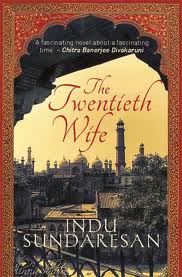
Book Review | The Twentieth Wife by Indu Sundaresan

It's a well founded opinion that knowing the half of something is worse than not knowing anything at all. It forms the basis of why historians love to pick at historical fiction. They point at the glaring inaccuracies, gross character embellishments and runaway prose that authors use to create dramatic tension and conflict, the corner stone of a good yarn. But for travelers and ardent fiction readers like me  historical fiction like The other Boleyn Girl or Anger & Ecstasy is the only we can understand the  importance of Tower of London or Michelangelo.

The Twentieth wife recounts the early life of Nur Jahan (nee Mehrunisa) and her turbulent relationship with Prince Salim otherwise known as  Emperor Jahangir (the fourth ruler of Mughal India and Emperor Akbar's son). It traces her almost mystical birth, her petulant adolescence, a failed marriage all leading up to becoming Jahangir's twentieth wife, all woven through a tapestry of Mughal court intrigue, love and deceit- the makings of a perfect historical chick-lit. Sundaresan's captures the zeitgeist of the time perfectly and her knowledge of court etiquette is impressive and, in my opinion, the lynch pin of the novel. It allows her to create beautiful miniatures of the time by talking about clothes, the architecture and even the food with exquisite detail. I would often end my reading session aching for a lamb curry and rice and a trip to Agra.

Mehrunissa herself is a somewhat disappointing character, possibly because she started out as nothing more than a beautiful bewitching social climber, a Kim Kardasian or perhaps even a Kate Middleton of her day, spurred on by her parents who made sure she got a great liberal arts education and a fair amount of freedom for a girl in her time. But more often than not, it feels like Sundarasan is struggling to create a clever and beguiling protagonist by giving her some political insight and overplaying her ability to withstand a bad marriage and infertility. This is probably because not much is known about her. The story of her early life is fabricated since very little was known of the woman until she wed Jahangir. It's quite possible that their erratic courtship is also unfounded. What is clear is that she was beautiful, wily and well versed in court politics possibly because of her closeness with Ruqayya. Sundarasen makes it clear that what Mehrunissa wanted most as a young girl was to be Empress and any real love for Prince Salim developed much later on. But who could blame her? Life was terrible for Mughal women unless you were a royal woman of importance. Things must be bad if becoming a concubine was an honour for the family and you best shot at a good life.  But Sundarasen's curiosity stemmed from the influence Nur Jahan wielded during her reign as Empress and ergo the novel and a journey through a somewhat interesting romance. No doubt once the two got to know each other, they made a formidable team.

The problem with historical fiction is that you cannot create likable characters and have to depend on men like Prince Salim, arrogant, ambitious and without any redeeming qualities. This is why fiction is so much better to work with. In many ways, Mehrunisa reminded me of Anne Boleyn. She teases Jahangir in the same way that Anne does Henry and uses her charms to make sure she became a queen and not a concubine. The Empress Nur Jahan, however, did not lose her head. Instead she went on to rule Mughal India in the Emperor's stead -he was in an opium filled haze, and was his last wife. She became formidable and that is Sundarasen's fodder for the sequel and I have a feeling I will like that Mehrunnisa much more. Let's be clear, this is no Wolf Hall. The pretty prose drags the book down in the middle and Mehrunisa's ebony hair featured one too many times. But there is no doubt the author is a gifted story teller that brings a glittering time to life- a time when we bathed in almond milk, had jewels that made the Kohinoor look like a trinket, and English monarchy look like peasants. I have already ordered the sequel and made plans to visit Fatehpur Sikri and revel in all its gloriousness.

Verdict: Buy. Perfect monsoon read while you munch on samosas and sip coffee.


Tuesday, November 20, 2012

Revival Review | The Exorcist by William Peter Blatty


The year is 2012. We are surrounded by vampires- most of them ridiculously good looking. Werewolves are largely misunderstood, but still manage to find the time to work on their abs in between bouts of angst ridden brooding. The world’s most watched television drama is about a zombie apocalypse. Three of this year’s most successful animated movies center around a young boy who can speak to ghosts, a dead dog brought back to life and a luxury resort for monsters run by Count Dracula.

Horror has become a pop culture staple, never more so than when it comes to demonic possession. In the last year alone we’ve been subjected to The Rite, The Devil Inside, The Last Exorcism and The Possession.   Yup, we’re surrounded by horror. And we love it.

But in 1971, the world was a very different place. Horror was predominantly escapist fantasy for teenage boys featuring classic movie monsters, things from outer space and scantily clad 50 feet tall women. Then along came a book that changed everything. That book was called The Exorcist and it taught us that horror was real, that it was lying in bed, upstairs. Waiting.
Tubular Bells, Part One by Mike Oldfield on Grooveshark


                                                                                               Mike Oldfield's Tubular Bells was the perfect 
soundtrack to the movie and continues to be haunting.
41 years hence, The Exorcist may no longer be as shocking and visceral a read as it was when it was first published, but it still remains one of the greatest horror novels ever written. As the New York Times Sunday Book Review memorably put it, “The Exorcist is to most other books of its kind as an Einstein equation is to an accountant's column of figures”.

The Exorcist created the original blueprint for what has now become Demonic Possession 101: young, innocent girl is possessed by malevolent demon and is then exorcised by Catholic priest.  But its power lies not in its fairly linear plot, but rather in its tone, manner and immensely compelling style. The Exorcist is not a horror novel written in a literary style. It is a literary novel that just happens to be terrifying.

William Peter Blatty shuns fast and easy thrills in favour of slow paced, simmering characterization. The book’s three principle protagonists - conflicted Jesuit priest Damien Karras, traumatized actress Chris MacNeil and her possessed daughter Regan all become living, breathing people that you actually find yourself caring about. The book’s titular character, Father Lankester Merrin only really joins the proceedings in the last 50 pages, yet at no point preceding this does one feel the need for things to get a move on.

While the 1972 film (as brilliant as it was) relied largely on visual shock tactics to deliver most of it scares, the book is more restrained and instead worms its way into your psyche far more insidiously. It is far more than a simple tale of good vs. evil and raises some profound questions regarding the nature of evil, faith and God himself.

Given the increasing amounts of real world horror that we are exposed to these days and the resultant nonchalance with which we have come to treat it, The Exorcist may no longer pack as terrifying a punch as it did all those years ago. However, its message and its underlying implications have never been more relevant than they have today.  Is an emaciated, foul mouthed, head spinning little girl the only manifestation of demonic possession? What about the child molester? The rapist? The murderer? The terrorist? The man who shoots his neighbour over a parking space?

We often talk about how the world we live in ‘is going to hell’. The Exorcist raises the chilling possibility of that particular metaphor being a little too literal for comfort.

Is The Exorcist ‘the scariest book ever written’? Probably not. But is it one of the most disturbing? Most definitely.Ultimately, the book’s power lies not in its ability to make you want to sleep with the light on (though it’ll do that as well, trust me) but instead in its ability to make you think about your own particular belief system- or lack thereof.

In his poem The Generous Gambler, Charles Baudelaire famously wrote “the most exquisite of the Devil’s wiles is persuading us that he does not exist”.

The Exorcist reminds us that not only does The Devil exist, but that he’s waiting for you. In that little room. Just up those stairs…

A little bit about our reviewer

John Thangaraj is 34 years old, and spends most of his time reading comics, listening to obnoxiously loud metal and playing with his dog (who does not like the obnoxiously loud metal).  He also occasionally finds the time to work, though given that he works in advertising, the actual definition of ‘work’ is ambiguous at best. Having been traumatized by his parents at the tender age of 7 by being made to watch The Omen, The Exorcist and Salem’s Lot in quick succession, he has a somewhat unhealthy obsession with horror and fantasy. His favourite authors include Stephen King, Road Dahl, Bill Bryson and Neil Gaiman. He thinks The Lord of the Rings rules and The Fountainhead sucks.  

Monday, November 5, 2012

Review | The Casual Vacancy

'Eastenders on Steroids' -That's my three word review of Rowling's The Casual Vacancy.  Eastenders - for those are fortunate enough not to have ever seen (Don't you lead a charmed life?)  is a long running soap on the BBC set in the East of London. There are clan wars, sordid affairs, pregnant teenagers and the odd attempt to acknowledge minority citizens. J K Rowling's book transposes that plot line onto a small british village, Pagford, that is thrown into disarray by the sudden death of a local councilman- Barry Fairbrother. The empty seat becomes the bone of contention as townsmen and women from different walks of life and differing personal agendas put their names forward to contest the seat, none of them deserving candidates in my opinion, which sets into motion a series of events that culminate, as always, in skeletons walking free of their closets, disillusioned suicidal teenagers and death. Through the dialogue and the prejudices, J K Rowling tries to weave in her own agenda, which is to lament the viciousness of gossip, breakdown of family values and the dark side of human nature. All of which is surprisingly entertaining, just like an episode of Eastenders.

Moving on from the plotline and into the writing, the first page reads like one from a Harry Potter novel. She takes on the usual third person omniscient view point- " Barry Fairbrother did not want to go out to dinner. [...]",  and setting the scene that will be the catalyst for the storyline moving forward. Rowling's tone is fairly acerbic through the entire book, especially when it comes to sex, which is abundant throughout the novel, as if overcompensating for the fact that she is a children's author. "The leathery skin of her upper cleavage radiated little cracks that no long vanished with decompressed." Toto, we're not in Hogwarts anymore! Especially since none of the characters, and I kid you not, none, not even the children are likable. Okay make the toddler. But that's it. So there's no Molly Wobbles or Dobby here to endear you to the book.

Rowling doesn't pull any punches whether it is commenting on the effects of racial bullying of a sikh teenage girl with too much facial hair or the debilitating effects of subliminal class warfare so deeply entrenched in the fabric of the village society, that it echoes in every dialogue. At the heart of the story is the battle between the success of rehabilitation and upward mobility. For instance,  can we, today,  take someone from a slum in mumbai, enroll him in Cathedral and watch him grow up to become a CEO of a major bank in twenty years. Will you allow your child to go to school with that kid from the slums? Will that child infect others with his grim view world or will he change? These are some of the topics Rowling addresses but in a terribly superficial manner, exactly like an Eastenders episode.

Rowling is a great storyteller and she really does reel you in with her seedy plot line but once you are done with it you're left feeling exactly the way you feel after you've bitched someone out- dirty and guilt ridden but quite ready to jump right in into the next bitching session.


Saturday, June 30, 2012

Revival | Peyton Place by Grace Metalious

"The blockbuster novel that shocked the nation" is the blurb on the book cover. As a teenager, the title was bandied about by my mother but I could never get my hands on it. It lay there on the top shelf out of reach along with the Valley of the Dolls. As my reading habits matured, it drifted in and out of my reading lists; the idea of reading about small town politics in the 1940's slowly move down past Jacqueline Susan and PD James (How dare she utter both authors in the same sentence, blasphemy!)

With the hoopla surrounding Fifty Shades of Grey, erotica has suddenly become fashionable and every 'Top Ten erotic reads' included this infamous novel. Finally when my mother, a big fan of the book when I was a teenager said, "That Fifty Shades of Grey is rubbish, give me Peyton Place any day. " I succumbed and finally ordered it.

And fifty pages in, I was sorely dissapointed. Not a flicker of a fu*k or a drop of an orgasm. How this book shocked America was beyond me but I am a tenacious reader and so persisted and finally- somewhere towards the middle, I began to understand what a clever clever lady Grace Metalious really was. 

The novel is set in small town USA that you and I have no relation to. This is not the America we are familiar with; the accents are strange. But the attitudes sound familiar and it sounds pretty. She paints us a grim picture in the first hundred pages or so. We are introduced to Allison the dreamer and her prude of a mother, Selena the gorgeous and her white trash family. We learn of the influential and the puritanical and we don't like it. Peyton place seems like a terrible place to live in. Then the girls get their periods and start to grow up. Soon there are hints of child abuse and terrible parenting all leading to disastrous consequences. It crescendoes to the inevitable when Selena realizes that she has grown up too much for her own good and pays the price of being too beautiful. Metalious writes in such a matter of fact tone- passing no judgement and taking no sides that you fell you're outside looking in at a little play. 

Time goes on and these characters grow up and they grow more self aware. There is the hint of the Takur mentality, where the landowners son can do as he pleases. If it had been a little less shocking, it would have made a fantastic Bollywood film. You see children's lives being destroyed in front of your eyes, years of trauma leading to mental instability; enemas as a way to control a son and incest as a way to control a daughter. You see the underlying sexual tension in every page, it reeks of it-this puritanical town. And oh my lord it shocks you to the very bone, to this day, that so many things happen behind closed doors. Metalious writes as if possessed, ripping the shiny veneer off small town hypocrisy by showcasing bigotry, lack of religious tolerance, and the complete destruction of a society. Take the Carter's for instance. What seems like a perfect family- lovely home with a picket fence and  two hardworking people who have nurtured a champion son, is soon transformed by backstory showing us what really lies beneath it all. And finally when you think, something good is still plausible, she tells us that the apple never falls too far from the tree.

She discusses abortion and teenage pregnancy in 1953 and that in itself must have caused such a furor. With so much jealously and hate, you wonder if this small town will ever redeem itself and it's finally given a chance. Most people get their just desserts and you walk away still thinking- my lord that's a pretty shitty place to live in but it's probably exactly the way my small town is. 

Her prose is evocative, especially because of her personification of nature. Indian summer is a feisty woman, winter an old crone. At times, it's a little fanciful and I admit to skipping a few pages of the story as the plot loses its way. But the book is not erotica, not in any sense. It does not make you feel sensual, which is what I believe erotica should be. But the book is about sex. It is about the freedom, the power and the role of sex in our societies, that how we see it determines who we become.

Some facts about Peyton Place


Verdict- Buy it- required reading.

A little bit about Revival. We read what we want here at the Caterpillar Cafe and a lot of times these are books that have been out for decades or even centuries and are classics- Dracula, Dante's The Divine Comedy, Shakespeare. We are reviving them from the dusty shelves and in the process shortening our reading lists a little. Enjoy our revivals! 

Thursday, June 14, 2012

Book Review | The Island by Elin HIlderbrand


Four has always been the magic number - three is a crowd and five is too many too characters to follow. There's Little Women – Meg, Jo, Beth and Amy (Die Amy Die)-Sorry, I digress, and of course Pride & Prejudice. Then we have contemporary versions-Sex and the City and Lipstick Jungle. The number four has been a magical in terms of women’s commercial literature and The Island by Elin Hilderbrand is no different. The only difference this time is that you have two generations, each trying to indulge the eccentricities of the other.  

Birdie is in the twilight of her life having had the courage to boot out her indifferent husband in exchange for freedom, a new found set of rules governing the single life and an acrimonious relationship with her eldest daughter, Chess. Don’t you just love how American names instantly conjure up acid washed shorts, lithe bodies and blond hair? Anyway, Birdie invites her daughter to a week’s holiday to their dilapidated family home in Tuckernuck- an idyllic island where the birds poop honey and everyone is deliriously happy without running water, to bond before Chess’s impending nuptials.  The engagement falls through and Chess- think prom queen with a bad attitude, shaves her head and extends the week into a month. The younger sister, Tate, comes along for the ride along with Birdie’s own sister Iris, who has her own steamy life to contend with at a ripe old age. Oh and there is a man, Barret, who comes in and throws it all out of sync as if it wasn’t already. Old memories soon begin to tiptoe out of the closet while new skeletons come out doing the salsa and a lot of cat- fighting ensues.

Anyone who has a sister or an extremely close female friend will acutely relate to the constant undercurrent of sisterly emotions like possessiveness, envy, loyalty, vindictiveness’ and that eerie awareness of each other which is mostly irritating but always useful. She manipulates these emotions perfectly to develop her story. 

And there is the Island, Tuckernuck- a privately owned island in Nantucket that Hilderbrand calls pure and simple and without any static from the outside world. The house plays an important part, each bedroom owning a space in the novel that tells us more about the character. Hilderbrand starts off a little sloppy, the dialogue a little predictable, but soon she sucks us in with fantastic detail, an evolving mystery and snappy repartees between the two sets of sisters. She leaves us clues like little breadcrumbs and we find that we really do want to know how it ends. This is a fantastic monsoon read as you are stuck in on a rainy day with a glass of wine or a cuppa tea.

Saturday, May 19, 2012

Books we love | Perfume by Patrick Suskind


Jean-Baptiste Grenouille was born in the cesspit known as Paris, sometime in early 18th century, when according to Suskind "The streets stank of manure, the courtyards of urine, the stairwells stank of mouldering wood and rat droppings, the kitchens of spoiled cabbage and mutton fat; the unaired parlors stank of stale dust, the bedrooms of greasy sheets, damp featherbeds , and the pungently sweet aroma of chamber pots. The stench of sulfur rose from the chimneys, the stench of caustic lyes from the tanneries, and from the slaughter houses came the stench of congealed blood. People stank of sweat and unwashed clothes; from their mouths came the stench of rotting teeth, from the bellies that of onions and from the bodies, if they were no longer very young, came the stench of rancid cheese and sour milk and tumors disease."

But not Grenouille, born beneath a swarm of flies, who had nought an odor. You can imagine the shock. Everything stank but this child and so he was passed from one home to another, each set of hands wanting to disengage in instant disgust. But this child had a gift. The gift of smell. He could smell the rocks on a seabed even as he was twenty miles inland. As he grew "he was no longer smelling mere wood, but kinds of wood:maple wood, oak wood, pine wood, elm wood, pearwood, old young rotting moldering, mossy wood down to single logs, chips and splinters." From this he created a vocabulary of odors and armed with his education he left for Paris.

By now I was hooked; the prose was akin to sinking your teeth into luxurious dark chocolate, so decadent, you bite into it and it begins to melt because of the heat emitted by your breath and hands. It coats your tongue and when its done, you lick the remnants off the outside of your mouth and perhaps the little big hanging from your chin.

I miss reading fairy tales. Sometimes I think back on the otherworldliness of Hansel and Gretel or Snow White and I wonder how they were ever written for children, their almost macabre plotting convincing me they are bastardized fairy tales for adults. Otherwise how can you explain a children's story that involved eating children as candy! Evocative and atmospheric, my scariest childhood character was the wicked Queen Ravenna. Patrick Suskind's Perfume is a fairy tale for adults and is the most extraordinary one I have read for a long time.

The story follows his adventures as a tanning apprentice, his entry into the hallowed world of perfumery and the resounding success of his creations and his coming to terms with the fact that despite his ability to deconstruct the composition of all animate and inanimate objects, he couldn't smell himself. He is shocked and horrified. Slowly a monster is born. We see him retreat from the world into an agonizing solitude and then reemerge stronger and with purpose. His purpose : to create scents by extracting them from living objects. How far does he go to create that almighty scent that will make him human?

Suskind's narrative tone is fairy tale like, filled with sardonic humor that belies the horror that he unleashes on us. This is story telling at its best and I am sure there is much that can be read between the lines. Perhaps there is a tale of morality tucked in somewhere there. The New York Times called it a "A fable of criminal genius..." Perhaps, But how can you when the lines are this beautiful.

A note on the hardback edition


Don't read this book as an e-book. This is the kind of book you want to keep, and even re-read at leisure. You want to feel the weight of it in your palms. It is published by one of my favorite publishers, Alfred K Knopf. This particular version is printed on thick paper with uncut edges.
Buy Perfume: The Story of a Murderer from Flipkart.com This version costs Rs 1078
There is ofcourse a penguin version at a very reasonable Rs 205 as well.


Like The Caterpillar Cafe on Facebook

Wednesday, March 28, 2012

Review | The Legacy of Hartlepool Hall

I had such great expectations from this book not only because I had just finished RSVP as recently as an hour before I picked this one up, but also because the trailer of the new movie Salmon Fishing in the Yemen, based on Torday's debut novel of the same name, looks bizarrely cool.

It's a simple story. Ed Hartlepool is an entitled little bugger who has spent the last five years in exile in France swimming 30 laps or so a day, while his family estate languishes under gross mismanagement, negligence and rising maintenance costs. The trustees call him back and explain to him, like they would a child, that he needs to sort it out, make a few decisions, and consider actually doing something with his day. Flummoxed, Ed returns to find himself neck deep in debt and hosting a strange Lady friend of his fathers, Lady Alice, who turned up one day and requested shelter. He begins to sort through the mess left behind by his lazy ancestors who never lifted a finger in their life, much like him, and walks around with a very 'deer in headlights' attitude while discovering that every fire continues to be lit in every room despite no one living there and his cook makes three course meals for people who don't exist, all because it has always been done that way.

Eagerly awaiting his return is childhood friend, Amanda, who is being slowly eaten at by her fathers acridity. Her only silver lining is her opportunistic real estate boyfriend who has his eyes set on turning the beautiful estate into condominiums. Supporting characters include a subservient aging butler and a jolly cook.  It's the perfect background for a great English laugh and we have a few in the beginning at the expense of Ed's bumbling and sheltered upbringing.  But soon you want him to snap out of it and grow a spine. The humor gets dry and Ed is left needing what protagonists require most, a character arc. It seems unbelievable that he could refuse to rise up to the challenge and by the middle of the book you want to slap him around. Amanda seems interesting enough and seems to take all her cues from an episode of  'Desperate Housewives' and her boyfriend is a portrayed as a stereotypical nouveau riche who lives beyond his means and would sell his mother to fund his lifestyle.

Paul Torday's writing is excellent and is splattered with a hint of Woodhouse; his eye for detail brings the old house to life so much so you want to fling the book at this unimaginative whiney protagonist. I appreciate that Hollywood and Richard Curtis have made us suckers for triumph in the face of adversity but if I wanted real life I would open the newspaper. I think Paul Toray wanted to take the veil off Wooster and his contemporaries and show them as they really are, worthless entitled sods who are out of touch in todays world, but it didn't work for me; give me the real Jeeves and Wooster any day. I am waiting for Season 3 of Downton Abbey.


Monday, March 19, 2012

Book Review | RSVP by Helen Warner


Last week The Economist came out with a chilling article, no it wasn’t about how the oil bubble was about to burst or a financial Armageddon, but about the demise of a much loved genre of our generation--Chick-Lit. Devastated, as the state of my near financial future is directly correlated to how this particular genre of women’s literature does on the shelves, I hiked up my skirt and ran to my nearest bookshop. Lo and behold, staring right in front of me was the zeitgeist of our times - vampire blood lust semi soft porn catering to teens, Nora Roberts, the new Michael Crichton novel and finally countless paperbacks with colorful pastel colors that made me sigh with relief. One such book was RSVP by Helen Warner. A novel about four girls- Anna, Clare, Ella, and Rachel, and how they battle with love lost and weight gained.

Anna is a dowdy teacher dragging herself through countless dreary days when she receives a wedding invitation from the ‘One that Got Away’. Obviously distraught she turns to Clare, a serial dater and tomboy sidekick, who convinces her to attend it. Ella, think Joan Collins from Dynasty sans the power shoulders since this woman is only a PA,  a consequence of being a bitch in university and wanting said man, is also considering attending the wedding. Finally Rachel, the women about to marry Anna's ‘One that Got Away’ has doubts on whether the object of everyone’s affection, is actually IN love with her.

Anna’s love story is told over a period of flashbacks that take us to Trinity College, a wasted opportunity, as Trinity could have by itself been the heart of the novel. But no, it features as a staid backdrop for a boring story of love at first sight. By far the most predictable yet most interesting character arc is that of Ella who is portrayed as devil incarnate. It has been a long time since I have actually encountered such a one-dimensional villain without an ounce of humour. I skipped many pages containing predictable dialogue and description, the man – I forget his name, is often described as ‘handsome’ or ‘with dazzling smile’. The climax revolves around the wedding scene, where the obvious takes place and the book ends as the sinner repents and the saint is rewarded.

The actual plot line had serious potential; anytime four women feature in a book and are friends, things are bound to get dramatic. This book is however never takes off and is perhaps a reason why chick lit is in demise. The writing is often lazy, refusing to give us anything but a constant commentary of what is going on in the heads of four girls instead of working to show us a little of their world outside, thereby allowing us to see the characters more clearly. The voices of three out of the four could have been easily interchanged and while I commend anyone who can get published, this was a difficult read. I believe even the simplest love story can be a journey filled with wit and drama. Candace Bushnell, Helen Fielding and Sophie Kinsella make you laugh, cry and wanting more.
Courtesy NovelWhore Blog

Long live the intelligent woman's need for romantic fiction! Helen Fielding-- when is your next book coming out? For more fun suggestions see the following posts Reviews|Return of the Chick-Lit. 

Wednesday, January 18, 2012

Book Review | Such a shame, Mr Darcy!

We now leave the the foggy streets of London and take a trip to the Pemberly estate to read Death Comes To Pemberly by P D James. Have you ever wondered how Lizzie and Darcy got on after they got over their pride and buried their prejudice. (Couldn't resist, sorry) Were they happy and did they fall deeply in love? Did Lizzie honestly marry him for love because I always suspected it was money? Did Jane find out that Mr Bingley was really a closet cross dresser? I always wished that Austen wrote a sequel and here we have it. Not by Austen but by the world's leading mistress of crime - P D James. Introducing her would take an entire post, so suffice to say that if there was going to be a crime at Pemberly, she should be the best person to write. It seems not.

The Guardian's Review made me chuckle!

Despite a few lukewarm reviews and a particularly sardonic one from The Guardian , I insisted on buying it. She is after all, P D James!
It all begins at Pemberly on the night leading up to a grand ball thrown in the honor of Mr Darcy's mother. James spends an inordinate amount of time summarizing a story that we all know so bloody well that by the fifth page you you want to say  - get on with it. Finally she does. That fateful night, a series of circumstances culminate in a murder involving that villain Wickham and arrest of a possibly innocent man. What transpires after is a slow detective story that plods along, there were no detectives or resources at the time to actually solve a crime. So it falls upon Darcy and a few old magistrates to get to the bottom of this most horrible incident that has befallen upon the great house of Pemberly. What conjecture follows involves a series of unnecessary summaries of the actual event. After a while I found myself thinking, "If I hear that one more time, I will throw this book." But I couldn't because it was an IPAD; The dark side of technology. Through it all we are never given a glimpse into the marriage we so want to be a part of or the character that made Ms Bennet so formidable. She seems to have morphed into this nervous whiny society woman that needs valium. Then there is the revelation of Mr Darcy's name but really, do we need to have another character with the same name? 

The silver lining however is Mr Darcy. This is really his story and I think that is where James is most comfortable. You realize that she always understood men better. She invests time in getting to know this man and pushing his buttons so that through the plot and dialogue, what little there is, we see various shades of his otherwise stoic character come to life. His tenderness is sublime along with his insight into himself and how his weaknesses have obstructed him from actually solving the case. 

The usual cast features to some degree, including the charming Mr Bennet. The ninety-year old P D James justified this book in an interview by saying that she did not want to die in the middle of a Dalgliesh story and really wanted to write something fun. While I hope she had a complete ball because her customary technique with plot fails to deliver here as this was a book that needed some fluffy emotional dialogue and James, always preferring to keep personal feelings at the periphery, struggles to make mundane conversation. Any glimpse we had of Dalgliesh's personal life was akin to a large bar of luxurious dark chocolate, not to be overindulged in. In this case, we needed more drama, more dialogue, more masala since the deduction is quite elementary and really Pride and Prejudice was after all one of the best chick-lits of all time.

Verdict - Only for  die hard PD James fans and those who just have to read any novel involving Darcy. I think it's worth it for him. Was never a fan of Lizzie anyway!
You can buy Death comes to Pemberly here.

My suggestion is to buy yourself a beautiful hardback edition of Pride and Prejudice, worth every penny instead.

And for a taste of PD James at her best, check out our post Rainy Day Reads


LinkWithin

Related Posts Plugin for WordPress, Blogger...